
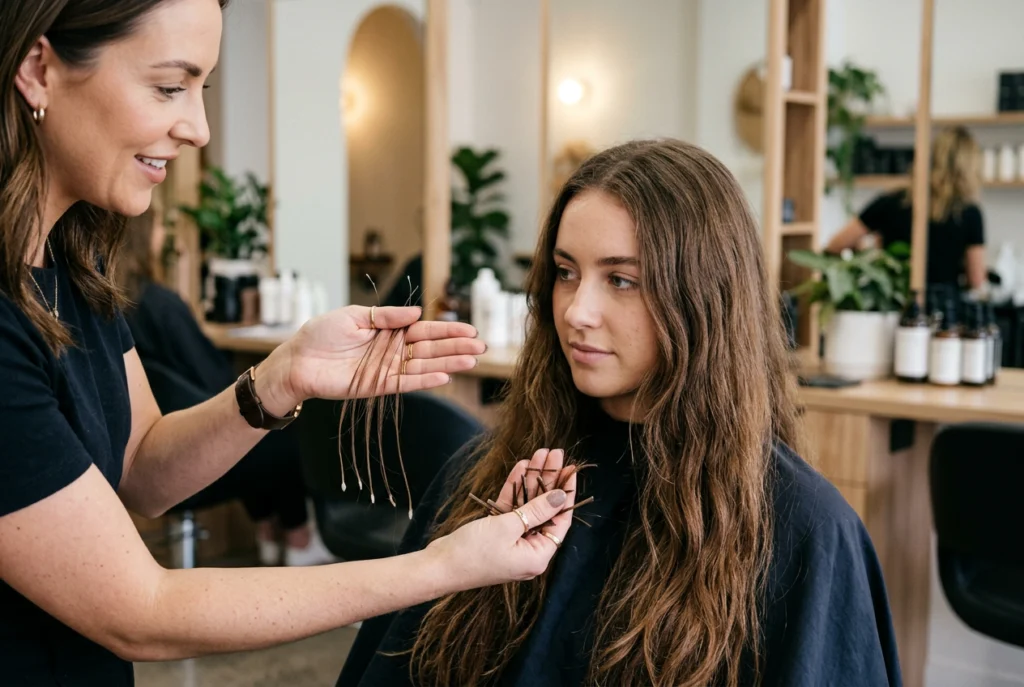
Noticing more hair on your pillow, in the shower drain or on your brush can feel alarming. The first question most Perth clients ask us is whether they are losing hair or simply breaking it. The two look similar at first glance, yet they point to very different causes and need different responses.
Understanding the difference helps you choose the right care at home and decide when it is time to book a professional consultation.
What Actually Happens When Hair Leaves Your Head
Hair follows a natural cycle. Each strand grows for several years, rests for a few weeks, then sheds so a new strand can take its place. This is shedding. On average, a healthy adult loses 80 to 100 strands a day. You rarely notice it because new growth keeps pace.
Breakage is mechanical. The strand snaps somewhere along its length, usually because the cortex or cuticle has been weakened by heat, chemicals, tension or repeated friction. The follicle is still healthy; the hair simply did not survive the journey to full length.
How to Tell the Difference at Home
Look at the hair you are finding.
– Shed hair has a small white bulb at the root. It tapers to a point at the tip. The strand is usually the same length as your current style.
– Broken hair has no bulb. Both ends look blunt or frayed. You often find shorter pieces mixed with longer ones, and the hair may feel rough or look thinner at the ends.
Run your fingers gently through a small section of dry hair. If you feel or see short, jagged pieces that were not there a week ago, breakage is likely. If entire strands with the root bulb are coming away, shedding is the main process.
Another quick check is the shower test. After washing, let your hair air-dry without brushing. Count the strands that fall on a white towel. If most have the white bulb and are full length, shedding is dominant. If many are shorter and frayed, breakage is the bigger issue right now.
Why Breakage Happens More Often Than People Expect
Australian hair faces specific stresses. Hard water in Perth leaves mineral deposits that make strands brittle. Frequent heat styling for our climate, combined with UV exposure and salt air near the coast, adds to the load. Tight ponytails, frequent brushing when wet, and heavy extensions or styles that pull on the hair shaft all increase the risk.
Professional sources note that skipping conditioner, rubbing hair dry with a towel, over-brushing and excessive heat styling are among the most common daily habits that turn healthy hair into breakage. The strand snaps before it can grow out, so the hair looks thinner even though the follicle is still producing.
Gentle Habits That Protect the Hair You Still Have
Small changes at home make a measurable difference.
Use a wide-tooth comb or a brush with soft bristles, especially on wet hair. Blot rather than rub when drying. Apply a light, non-drying hairspray or leave-in treatment that reduces friction. Keep heat tools on the lowest effective temperature and always use a protectant.
Conditioner is not optional. It smooths the cuticle and reduces the chance of the strand catching and snapping. If your hair feels dry or rough, a weekly protein treatment or bond-building mask can help restore strength between salon visits.
When you wear extensions or tight styles, give your hair regular breaks. Professional application with the right weight and tension minimises stress on the natural hair. Our team at Circles of Hair always matches the method and weight to the client’s hair density so the result looks beautiful without creating new breakage.
When to Book a Consultation
If you have ruled out obvious mechanical causes and are still seeing large amounts of hair with the root bulb, or if you notice patchy areas, it is worth speaking with a professional. A dermatologist or trichologist can assess whether an underlying condition is accelerating shedding. At the salon we can review your current routine, check for product build-up or heat damage, and recommend treatments that strengthen the hair that is still growing.
Many clients come in concerned about loss and leave with a clearer picture and a simple care plan. Sometimes the solution is as straightforward as changing how you dry your hair or adding a bond-building treatment to your colour service.
Moving Forward With Confidence
Hair that sheds naturally is not a problem to fix. Hair that breaks is a signal that something in the daily routine or styling habits needs adjustment. The good news is that both situations respond well to consistent, gentle care.
If you are unsure which you are seeing, bring a few sample strands to your next appointment. We can look at them together under good light and talk through the practical steps that will give you the healthiest hair possible for your lifestyle.
Book a consultation at our Subiaco or Fitzgerald salon, or ask us any questions when you are next in. We are here to help you understand your hair and keep it looking its best.
Contact us if you cannot tell breakage from shedding in the brush.