
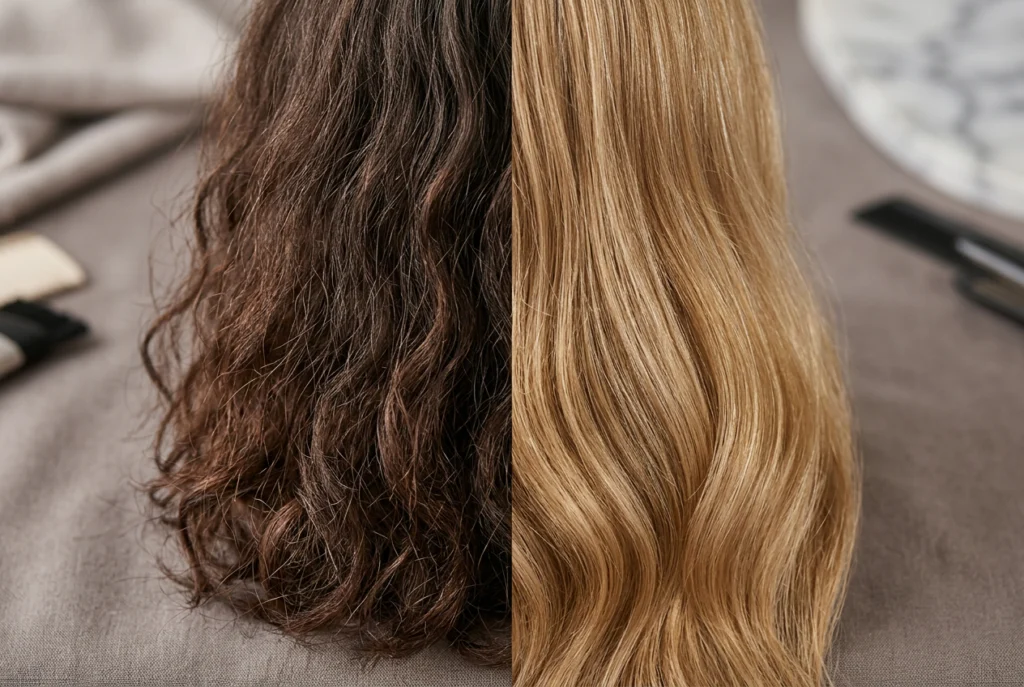
Hair porosity describes how readily your strands absorb and hold moisture. The cuticle layer, the outer shield of overlapping scales, determines whether moisture enters easily or resists penetration. At Circles of Hair we assess porosity during every consultation because it directly influences colour results, treatment choices and the products that will actually work for you in Perth conditions. The two target keywords high porosity vs low porosity hair and hair porosity explained sit at the centre of this guide because understanding the difference changes how you care for your hair between salon visits.
How to Test Your Hair Porosity at Home
The float test gives a reliable starting point. Place a clean strand of hair in a glass of room-temperature water. Hair that sinks quickly within two to four minutes usually has high porosity. Hair that floats for several minutes points to low porosity. Hair that sinks slowly after four to six minutes typically sits in the medium range.
Feel and behaviour provide further clues. High-porosity hair often feels rough or straw-like when dry and absorbs water instantly in the shower. Low-porosity hair feels smooth and can take several minutes to feel fully wet. Colour that fades within a few weeks or hair that becomes frizzy in humidity also signals porosity issues we see daily in our Subiaco and Fitzgerald salons.
Another simple check involves product absorption. Apply a small amount of water or a light leave-in to dry hair. High-porosity hair drinks it in within seconds. Low-porosity hair leaves the product sitting on the surface for minutes. These observations help our stylists recommend the right treatment the moment you sit in the chair.
High Porosity Hair: Signs, Causes and What It Needs
High-porosity hair has a raised or damaged cuticle that lets moisture rush in but allows it to escape just as fast. You may notice it dries in under ten minutes, feels brittle at the ends, or loses colour vibrancy within three or four washes. Chemical lightening, frequent heat styling, Perth’s hard water and sun exposure all contribute to raised cuticles.
This hair type benefits from a careful balance of protein and moisture. Bond-repair treatments such as K18 reconnect broken keratin chains in four minutes without rinsing. Kérastase Première or L’Oréal Metal Detox neutralises the metal deposits that Perth tap water leaves behind, preventing further cuticle damage during colour services. At home, leave-in conditioners with lightweight oils and weekly protein masks help seal the cuticle without weighing the hair down.
We customise every colour formula to your hair’s porosity so the cuticle closes properly and colour molecules stay locked in longer. Our stylists check elasticity and porosity at the basin before recommending the right add-on treatment for that appointment. High-porosity clients often leave with a bond-repair treatment, a lightweight leave-in and a weekly protein mask. The same diagnostic approach ensures the colour we apply today still looks fresh in four weeks.
Low Porosity Hair: Signs, Causes and What It Needs
Low-porosity hair has a tightly bound cuticle that resists moisture entry. Water and products tend to sit on the surface rather than penetrate. You may find your hair takes twenty minutes or more to feel fully wet, or that heavy butters and oils create build-up rather than softness.
Heat helps open the cuticle temporarily so moisture can enter. Applying a warm towel or using a hooded dryer with a light mist of water and a leave-in conditioner makes a noticeable difference. Clarifying shampoos used once a fortnight prevent product residue from blocking absorption. Lightweight, water-based leave-ins and sprays perform better than thick creams.
Our colourists adjust developer strength and processing times for low-porosity hair to achieve even lift and deposit without over-processing the cuticle. The same diagnostic approach we use for high-porosity clients ensures low-porosity hair receives the right treatment, often a gloss or moisture-focused Kérastase Ritual rather than a heavy bond builder. Low-porosity hair responds well to heat-assisted application during in-salon treatments and benefits from lighter home-care routines that avoid heavy occlusion.
Medium Porosity Hair
Medium-porosity hair maintains a balanced cuticle that accepts and retains moisture without extremes. It responds well to most professional treatments and requires less corrective work. Regular glosses and seasonal moisture treatments keep the cuticle smooth and colour vibrant. We still assess it at every visit because water quality, heat use and chemical services can shift porosity over time. Medium-porosity clients often focus on maintenance glosses and seasonal adjustments rather than intensive repair.
Why Porosity Matters for Colour and Treatments at Circles of Hair
Porosity affects how colour develops and how long it lasts. High-porosity hair can grab colour too quickly and then release it, while low-porosity hair may resist even uptake. Our team checks porosity before every colour service so the formula, developer and processing time match your hair exactly. The client site explains that formulas are customised to your hair type, porosity, and colouring history, which is why we never use a one-size-fits-all approach.
The same principle applies to treatments. Snapping or stretchy hair after lightening usually needs K18 or Innoluxe bond repair. Colour that turns brassy or fades fast in Perth water responds to Metal Detox or Kérastase Première. Dull, flat colour benefits from Chroma Gloss. Dry, rough hair improves with Fusio-Dose or Oribe Renewal. Your stylist diagnoses on the day rather than following a fixed menu. The treatments page details how we check elasticity and porosity during every consultation and match the service to what your hair is actually doing that day.
Practical Care Recommendations From Our Stylists
High-porosity clients often leave with a bond-repair treatment, a lightweight leave-in and a weekly protein mask. Low-porosity clients receive advice on heat application, clarifying frequency and lighter styling products. Medium-porosity clients focus on maintenance glosses and seasonal adjustments. All clients receive a short list of two or three products that match their current hair condition. Free salon pickup or free shipping over $150 makes it easy to maintain results between visits.
We also guide clients on how Perth water interacts with porosity. Metal build-up from local tap water can roughen the cuticle further, making high-porosity hair even more prone to breakage and low-porosity hair even more resistant to moisture. Regular Metal Detox or Kérastase Première services counteract this specific local factor.
How Our First-Party Approach Supports Your Hair Journey
Every client’s hair is different on any given day. Porosity is one of the key variables we read at the basin. The same stylist who applies your colour or cut also recommends the treatment that matches your hair’s current state rather than selling a single product to every client.
Book a Porosity Assessment
Understanding whether your hair leans high, low or medium porosity removes the guesswork from product choices and colour expectations. Our team at Subiaco and Fitzgerald diagnoses porosity, elasticity and the effects of Perth water during every appointment. Book your next colour, cut or treatment and ask us to walk you through what your hair needs right now. We look forward to helping you achieve the healthy, manageable hair you want.
High porosity vs low porosity hair is not a fixed label. It is a practical framework that helps you and your stylist choose the right services and products every time you visit. Hair porosity explained through real-world testing and professional diagnosis leads to better colour retention, fewer breakage issues and hair that feels good day after day. Perth water, sun exposure and the chemical services many clients choose all influence porosity over time, which is why we reassess at every appointment rather than assuming yesterday’s diagnosis still holds. Contact Circles of Hair to start the conversation about what your hair actually needs right now.
Get in touch if the porosity test does not match how the hair feels.